
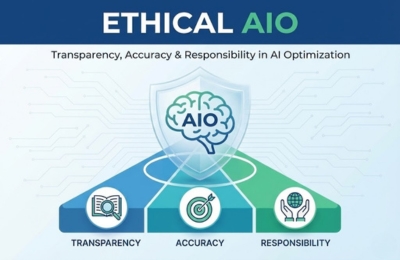
Ethical AIO focuses on optimizing content for AI systems without compromising truth, transparency, or fairness. Instead of manipulating models, it aligns optimization with accuracy, responsible representation and clear disclosure, ensuring brands earn long-term trust in AI-driven discovery environments.
Ethical AIO
As AI-powered search engines and large language models increasingly shape how information is surfaced, optimization is no longer just a technical exercise. It is a governance responsibility. Ethical AIO sits at the intersection of visibility, trust and accountability, ensuring that brands are not only discoverable inside AI answers but also represented accurately and responsibly.
Unlike traditional SEO, where ranking mechanics often dominate strategy, AIO influences how knowledge is interpreted, summarized and reused by systems like ChatGPT, Gemini, Claude and Perplexity. That shift makes ethics foundational, not optional.
Ethical AIO is about earning inclusion rather than forcing it.
Why ethics matter in optimization
AI systems do not simply retrieve pages; they infer meaning. They compress narratives, select sources, and synthesize perspectives. When optimization prioritizes short-term exposure over integrity, it introduces risk misrepresentation, hallucinated authority, or misleading summaries that can scale instantly.
From a governance standpoint, ethical AI marketing recognizes that every optimization decision influences how AI “understands” a brand or topic. That understanding may then propagate across thousands of user interactions.
Key reasons ethics now matter in AIO include:
- Amplification risk: Errors scale faster in AI summaries than in traditional search results.
- Trust decay: Inaccurate or misleading content reduces long-term AI confidence signals.
- Regulatory pressure: Transparency and accountability expectations are increasing globally.
- Brand safety: Misaligned AI interpretations can damage credibility beyond SEO metrics.
Ethical AIO reframes optimization from manipulation to stewardship, ensuring that influence over LLM answers is exercised responsibly. This aligns directly with strategies designed to influence LLM answers through clarity and consistency, not distortion.
Accuracy first
Accuracy is the non-negotiable foundation of responsible AI SEO. AI models reward consistency and factual reliability over time. When content exaggerates claims, blurs distinctions, or implies expertise without substantiation, models eventually deprioritize or reframe it.
Accuracy-first AIO practices include:
- Clear separation between facts, opinions and forward-looking statements
- Avoiding overgeneralized claims or inflated credentials
- Maintaining alignment between headlines, body content and summaries
- Updating content when context, definitions, or standards change
For example, AI systems often cross-validate information across multiple sources. If one page positions a brand as an industry authority while others describe it more narrowly, the model resolves the conflict often by downgrading perceived expertise.
Ethical AIO treats precision as a ranking signal for AI trust, not merely editorial polish.
Transparent content practices
Transparency is what allows AI systems and human readers to assess intent. transparent AIO does not attempt to disguise marketing as a neutral authority or obscure the origin of claims.
Effective transparency practices include:
- Clear authorship and ownership signals
- Explicit framing of promotional, educational, or opinion-based content
- Avoidance of deceptive structuring designed to simulate third-party endorsement
- Consistent disclosure across platforms and formats
AI models increasingly infer credibility from disclosure patterns. Content that openly communicates who is speaking, why the content exists and what perspective it represents is easier for models to classify accurately.
Transparency also improves alignment with ethical AIO frameworks, where optimization supports understanding rather than gaming interpretive gaps.
Fair representation standards
Fair representation is one of the most overlooked aspects of ethical AI marketing. Optimization strategies that suppress nuance, over-simplify complex topics, or crowd out alternative viewpoints introduce bias into AI outputs.
Ethical AIO sets standards for:
- Representing competitors, alternatives, or limitations honestly
- Avoiding exclusionary language or selective framing
- Ensuring balanced coverage when addressing multi-stakeholder topics
- Preventing false equivalence or exaggerated differentiation
AI systems learn patterns of framing. If content consistently positions one solution as universally superior without acknowledging context, the model may either discount the source or repeat a biased narrative; both outcomes carry reputational risk.
Fair representation strengthens long-term AI trust by signaling editorial responsibility rather than agenda-driven optimization.
Ethical review checklist
Before publishing or updating AIO-optimized content, ethical review should be a formal step, not an afterthought. A structured checklist ensures governance principles are applied consistently.
An ethical AIO review should confirm:
- The content is factually accurate and current
- Claims are proportional and verifiable
- The intent of the content is transparent
- Representation of entities, topics and alternatives is fair
- Optimization techniques do not mislead AI interpretation
This checklist reinforces internal accountability while aligning with broader standards promoted by organizations such as the AI Ethics Institute, which emphasizes responsibility and transparency in AI-driven systems.
Ethical AIO is not slower; it is more durable.
FAQs
What is ethical AIO?
Ethical AIO is the practice of optimizing content for AI systems while prioritizing accuracy, transparency and responsible representation instead of manipulation or misleading tactics.
How does ethical AIO differ from traditional SEO?
Traditional SEO focused on ranking mechanics, while ethical AIO governs how content is interpreted, summarized and reused by AI models across multiple platforms.
Why is transparency important in AI optimization?
Transparency helps AI systems correctly classify content intent, improving trust signals and reducing the risk of misrepresentation or credibility loss.
Can ethical AIO improve long-term visibility?
Yes. Ethical AIO strengthens AI confidence signals over time, increasing the likelihood of consistent inclusion in AI-generated answers.
Conclusion
AI optimization has matured beyond visibility tactics. It now operates in an ecosystem where trust, interpretation and responsibility determine whether content is reused, summarized, or ignored by intelligent systems.
Ethical AIO ensures that optimization supports accurate understanding, transparent intent and fair representation, protecting both brand credibility and the integrity of AI outputs. In a world where AI answers increasingly replace traditional search journeys, ethics are no longer a moral add-on. They are a strategic advantage.