
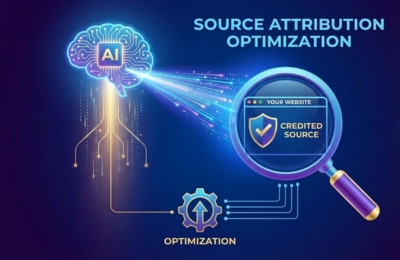
AI systems do not cite sources randomly. They use attribution scoring models that evaluate trust, clarity, consistency and formatting signals before deciding whether to credit a website. This guide explains why attribution fails, what citation signals LLMs rely on and how to structure content so your brand is more likely to be referenced, credited and cited inside AI-generated answers.
Source Attribution Optimization
Source attribution optimization is the practice of increasing the likelihood that AI systems explicitly credit your website when generating answers. As AI-powered search and conversational interfaces replace traditional blue-link results, visibility without attribution has become a silent risk. Being “used” by AI is no longer enough being credited is the new competitive advantage.
Large language models do not behave like search engines. They do not simply surface the highest-ranking page. Instead, they synthesize information from multiple sources and apply internal confidence and attribution thresholds before deciding whether a source is worth naming.
Understanding how attribution works is now essential for brands operating in AI-first discovery environments.
Why AI Sometimes Doesn’t Credit Sources
AI models frequently generate correct answers without naming where the information came from. This is not a bug; it is a design outcome.
Attribution failures usually occur for three reasons.
First, the content is semantically useful but not attribution-worthy. Many pages explain a topic accurately, but do not establish themselves as a source of record. In these cases, the AI absorbs the knowledge but does not consider the publisher distinctive enough to cite.
Second, the information appears widely duplicated. If similar phrasing, data points, or explanations exist across multiple websites, attribution confidence drops. The model cannot determine a clear origin, so it responds without citations or with generic phrasing.
Third, the source lacks attribution clarity. Pages without clear authorship, timestamps, citations, or structural cues make it harder for AI systems to confidently assign credit. When confidence is low, models default to unattributed synthesis.
This is why many brands notice their ideas showing up inside AI answers without their name attached.
Attribution Signals Models Use
AI attribution decisions are driven by probabilistic scoring rather than explicit rules. While models do not publish their full logic, consistent patterns have emerged from observed citation behavior and published research, including studies referenced by OpenAI.
Key attribution signals include:
Source clarity signals
Clear author identification, publication dates, topical focus and structured formatting help AI systems identify a page as a definable source rather than generic content.
Consistency and repetition signal
When a brand publishes aligned explanations across multiple authoritative pages, the model builds confidence that the brand “owns” a specific narrative or framework.
Originality signals
Unique frameworks, models, definitions, or structured explanations are more likely to be cited than generic summaries. AI systems are more willing to attribute when they detect non-derivative thinking.
External reinforcement signals
Mentions, references and alignment across trusted domains strengthen attribution confidence. Even without direct links, consistent brand mentions reinforce legitimacy.
Formatting and extractability signals
Well-structured sections, concise definitions and logically segmented explanations make it easier for AI to extract and credit a source.
Attribution scoring is cumulative. No single signal guarantees a citation, but strong alignment across multiple signals significantly increases the probability.
How to Increase Citation Probability
Increasing citation probability requires intentional content engineering, not superficial optimization.
Start by writing with attribution in mind. Pages should answer questions in a way that clearly signals ownership of the explanation. This includes introducing concepts with definitional authority rather than descriptive vagueness.
For example:
- A generic explanation may be used but not cited.
- A clearly framed, named framework or model is far more likely to be attributed.
Second, reinforce the same concepts across your site. Internal links to related topics such as brand authority AI, source attribution AI and AIO, AEO & GEO help AI systems understand that your site consistently covers and owns a topic cluster.
Third, explicitly connect claims to evidence. When referencing studies or industry findings, link to authoritative external research such as OpenAI citation studies. This improves trust signals and positions your content as responsibly sourced.
Finally, avoid fragmentation. Splitting similar explanations across dozens of thin pages weakens attribution confidence. Consolidated, authoritative pages outperform scattered content when it comes to AI citations.
Attribution Formatting Best Practices
Formatting plays a larger role in attribution than most teams realize.
Effective attribution formatting includes:
- Clear H1–H3 hierarchy aligned to a single topic
- Short definitional paragraphs early in each section
- Explicit cause-and-effect explanations
- Consistent terminology without synonym drift
- Logical progression from concept → mechanism → outcome
For example, AI systems are more likely to credit a page that defines source attribution AI in a single, authoritative paragraph than one that loosely references it across multiple sections.
Another best practice is contrast-based explanation. Showing different citation outcomes, such as “what happens when attribution signals are weak vs stron,g” helps AI models understand that your content is explanatory, not repetitive.
This is especially effective when paired with internal links that reinforce the same terminology across related pages.
Measurement Checklist
Because attribution is probabilistic, measurement must be observational rather than absolute.
Use the following checklist to evaluate progress:
- Are your brand name and explanations appearing inside AI answers, even without links?
- Are certain pages being paraphrased repeatedly across AI tools?
- Do some queries trigger citations while others do not?
- Are your frameworks or terms being referenced verbatim?
Tracking citation presence across ChatGPT, Gemini, Claude and Perplexity over time reveals patterns. Improvements typically appear gradually as attribution confidence builds.
This is also where internal alignment with brand authority AI and broader AIO, AEO & GEO initiatives becomes critical. Attribution rarely improves in isolation.
FAQs
How do I get AI to cite my brand?
AI cites brands when attribution confidence is high. This requires clear authorship, original explanations, consistent topic coverage and strong formatting that signals source ownership.
Why does AI use my content but not credit it?
This usually happens when content is helpful but not distinctive, duplicated elsewhere, or lacks clear attribution signals such as authorship, structure, or originality.
Do backlinks guarantee AI citations?
No. Backlinks help authority, but AI attribution depends more on clarity, consistency and originality than traditional link metrics alone.
Can attribution be measured directly?
Attribution cannot be forced or guaranteed, but it can be observed by tracking brand mentions, paraphrasing patterns and citation behavior across AI platforms over time.
Conclusion
Source attribution optimization is not about forcing AI systems to cite you. It is about making attribution the most logical outcome.
When your content is clear, original, consistently reinforced and structurally optimized, AI models gain the confidence required to attach your name to the knowledge they generate. As AI-driven discovery becomes the default interface, brands that invest in attribution readiness will compound visibility, trust and recall while others remain invisible contributors.
Being cited is no longer optional. It is the new signal of authority.