
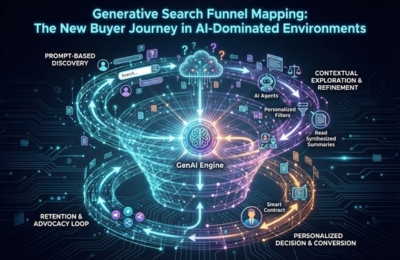
The generative search funnel replaces linear, click-based marketing funnels with AI-mediated decision paths shaped inside LLMs like ChatGPT, Gemini, and Perplexity. Buyers no longer move page by page; instead, AI compresses awareness, consideration, and conversion into a single conversational layer. This guide introduces a proprietary funnel framework to map, influence, and optimize buyer decisions in AI-dominated environments.
Generative Search Funnel
Traditional funnels assumed one thing: users move.
From ads to blogs, from blogs to landing pages, from landing pages to conversion.
Generative search breaks that assumption.
In AI-powered environments, the funnel does not live on your website alone. It lives inside large language models that interpret intent, synthesize information, and recommend outcomes before a click ever happens. The generative search funnel is not a sequence of pages. It is a sequence of AI-mediated judgments.
This shift requires a fundamentally new way to think about funnel design, optimization, and measurement.
This article introduces a new framework for AI funnel mapping, designed specifically for generative search systems and conversational discovery.
How AI Changes Buyer Journeys
The classic buyer journey was observable. Marketers could track impressions, clicks, sessions, and conversions.
The AI buyer journey is mostly invisible.
When a user asks:
- “Which cybersecurity vendor is safest for mid-sized enterprises?”
- “What’s the best_toggle platform for B2B SaaS onboarding?”
- “Who should I trust for enterprise AI consulting?”
The AI does not return a list of links. It returns a synthesized answer. That answer reflects:
- Prior training data
- Reinforcement signals
- Entity authority
- Consistency of narratives
- Risk alignment and safety scoring
In other words, the buyer journey now begins inside the model, not on your homepage.
This has three implications:
- Awareness is inferred, not visited
- Consideration is evaluated, not browsed
- Conversion is influenced before interaction
This is why AI funnel mapping must focus on how models reason, not how users click.
Awareness Stage Inside LLMs
In generative search, awareness does not mean “traffic.”
It means recognition.
At the awareness stage, LLMs decide whether your brand, product, or concept is even eligible to be mentioned. This eligibility is shaped by:
- Entity clarity and disambiguation
- Repetition across trusted sources
- Alignment with known problem spaces
- Absence of misinformation flags
If an AI model cannot confidently explain who you are and what you do, awareness fails silently.
In the generative search funnel, awareness is binary:
- You are either part of the answer
- Or you are excluded entirely
This is where internal practices like AI safety alignment and anti-misinformation AI structuring matter. AI systems are conservative. They prefer sources that are:
- Consistent
- Non-contradictory
- Clearly scoped
Awareness optimization, therefore, is not about reach. It is about interpretability.
Consideration Stage Inside Generative Search
In traditional funnels, consideration meant comparisons, reviews, and feature pages.
In generative environments, consideration is compressed into model-level evaluation.
LLMs do not “compare” by clicking tabs. They compare by weighing:
- Conceptual completeness
- Trade-off explanations
- Use-case specificity
- Risk disclosure quality
During the consideration phase, the AI asks implicitly:
- Does this brand explain why and when it is appropriate?
- Does it acknowledge limitations?
- Does it demonstrate depth beyond marketing claims?
This is where the generative conversion model diverges sharply from SEO-era logic. Overly promotional language reduces trust. Balanced explanations increase inclusion.
Brands that perform well at this stage tend to:
- Publish decision-oriented content
- Address objections directly
- Use structured, factual language
- Maintain narrative consistency across platforms
This stage is also heavily influenced by AEO and GEO principles, where content is designed to be answerable, not just discoverable.
Conversion Stage in AI
Conversion no longer starts at the checkout page.
It starts when the AI frames the recommendation.
By the time a user clicks, emails, or books a call, the decision has often already been shaped. The AI has:
- Narrowed options
- Set expectations
- Defined perceived value
In the generative search funnel, conversion is assisted, not triggered.
This changes how marketers should think about CTAs. Instead of asking, “How do we get the click?” the better question is:
“How does AI describe the moment of readiness?”
High-performing brands align conversion content with:
- Clear next-step framing
- Risk-aware positioning
- Outcome-focused explanations
This is where AIO, AEO & GEO strategies converge. Conversion happens when AI is confident that recommending an action will not mislead the user.
Funnel Optimization Plan
Optimizing the generative search funnel requires a shift from page optimization to model alignment.
A practical funnel optimization plan includes:
Entity-first structuring
Ensure your brand, services, and categories are clearly defined and consistently referenced across content.
Narrative consistency checks
Conflicting explanations across blogs, landing pages, and PR confuse LLMs and weaken funnel progression.
Stage-specific content design
- Awareness: clear definitions and scope
- Consideration: trade-offs, comparisons, use cases
- Conversion: readiness signals and next-step clarity
Safety and trust alignment
Integrate AI safety alignment principles to avoid risk-based suppression in generative answers.
Continuous AI feedback analysis
Monitor how your brand appears in AI-generated responses and refine content accordingly.
Industry research, including insights from the Gartner Buyer Journey Report, consistently shows that B2B and high-consideration purchases now involve fewer visible steps but more cognitive evaluation upfront. Generative systems accelerate this trend.
FAQs
How does AI change marketing funnels?
AI compresses traditional funnels by handling awareness, consideration, and recommendation inside the model, reducing reliance on step-by-step website navigation.
What is a generative search funnel?
A generative search funnel maps how AI systems interpret, evaluate, and recommend brands during conversational search rather than click-based journeys.
How do I optimize for AI buyer journeys?
Focus on entity clarity, consistent narratives, structured explanations, and safety-aligned content that AI models can confidently summarize and recommend.
Does generative search replace SEO funnels?
It does not replace SEO entirely but reorders priorities. Visibility inside AI answers increasingly precedes and influences traditional traffic-based funnels.
Conclusion
The buyer journey has not disappeared. It has moved upstream.
The generative search funnel reflects a reality where AI interprets, filters, and frames decisions before users ever reach your site. Brands that continue to optimize only for traffic will struggle to influence outcomes they can no longer see.
By adopting structured AI funnel mapping, aligning content with AI reasoning patterns, and designing for awareness, consideration, and conversion inside generative systems, organizations can regain control of influence in AI-dominated environments.