
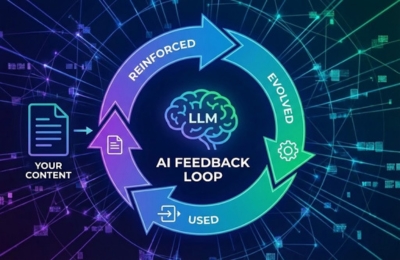
The AI feedback loop explains how large language models (LLMs) repeatedly reuse, reinforce and evolve trusted content over time. Once AI systems identify your content as reliable, it becomes part of a self-reinforcing cycle where visibility, reuse and authority compound. This article breaks down how that loop works, how ranking shifts emerge from feedback signals and how brands can intentionally benefit from this system instead of being passively shaped by it.
AI Feedback Loop
The rise of AI-powered search has fundamentally changed how content gains visibility. Unlike traditional SEO, where rankings reset with every algorithm update, LLM-driven systems operate through cumulative memory and reinforcement.
The AI feedback loop is the process through which AI models absorb, reuse, validate and re-prioritize content over time. Content that performs well does not simply rank once; it becomes part of an evolving knowledge structure that influences future answers, summaries and recommendations.
Understanding this loop is essential for any brand operating at the intersection of SEO, AIO and generative search.
How AI Reuses Your Content Over Time
LLMs do not “crawl” content in the same way search engines historically have. Instead, they identify patterns of reliability, clarity and consistency across multiple exposures.
When AI systems encounter your content repeatedly and in aligned contexts, they begin to treat it as a stable reference point. Over time, this leads to reuse in multiple forms:
- Direct factual reuse in generated answers
- Conceptual paraphrasing across different queries
- Structural imitation in explanations and frameworks
- Implicit preference during answer synthesis
This is where self-training LLM loop behavior emerges. While models are not retrained live on individual websites, their response generation becomes shaped by reinforced patterns from trusted sources.
Content that is consistently accurate, well-structured and aligned with a clear entity narrative is far more likely to be reused than content that merely ranks once and disappears.
Reinforcement Cycles
Reinforcement is not random. It follows predictable cycles driven by exposure, validation and repetition.
A typical reinforcement cycle looks like this:
- Your content is surfaced in response to a query
- Users engage positively or do not challenge the output
- The model associates your source with reliability for that topic
- Future responses increasingly draw from similar patterns
- Competing or conflicting content is deprioritized
These content reinforcement signals accumulate quietly. Unlike backlinks or rankings, you rarely see them directly, but their impact compounds over time.
This is why brands that invest in an AIO brand manual and long-form, structured explanations often dominate AI answers months later, even if they were not initially the loudest voices.
Reinforcement favors consistency over novelty and depth over frequency.
Feedback-Driven Ranking Shifts
Traditional ranking volatility was driven by algorithm updates. In AI search, ranking shifts happen through feedback.
When an LLM repeatedly sees your content used without contradiction, it becomes a safer choice. Over time, this produces visible outcomes:
- Your brand appears more often in AI summaries
- Your explanations are echoed across platforms
- Competing content is paraphrased using your framing
- AI answers stabilize around your terminology
These feedback-driven shifts explain why some brands suddenly become “default answers” in tools like ChatGPT or Perplexity, even without recent publishing activity.
This is also why poorly structured or ambiguous content slowly disappears from AI-generated responses. Once negative feedback patterns emerge, reinforcement works in reverse.
How to Benefit From the Loop
You cannot control the AI feedback loop, but you can design content to align with it.
High-performing content inside this system shares common traits:
- Clear topical ownership rather than scattered coverage
- Stable terminology and definitions across pages
- Long-form explanations that resolve ambiguity
- Internal consistency is supported by strong internal linking
Linking conceptually to resources such as your long-form AIO content strengthens semantic alignment and reinforces topic authority across your ecosystem.
Externally, AI platforms themselves acknowledge iterative improvement cycles. OpenAI documents these mechanisms in its Train-Refine approach, illustrating how systems improve through feedback rather than one-time ingestion.
The goal is not virality. The goal is to become predictable, reliable and reusable.
Expected Patterns
Once your content enters a positive AI feedback loop, several patterns typically emerge:
- Gradual but persistent increase in AI visibility
- Reduced volatility compared to traditional SEO
- Reuse across unexpected query variations
- Longer lifespan of individual content assets
These patterns favor organizations that think in years rather than weeks. The payoff is cumulative authority, not short-term spikes.
Brands that fail to recognize these dynamics often chase constant updates, while those who understand the loop focus on reinforcing what already works.
FAQs
How does AI reuse my content?
AI reuses content by identifying reliable patterns in structure, accuracy and clarity. Over time, trusted content is paraphrased, summarized and referenced across multiple responses.
What is an AI feedback loop?
An AI feedback loop is the cycle where content exposure, validation and reuse reinforce each other, increasing the likelihood that AI systems rely on the same sources repeatedly.
Does updating content frequently help reinforcement?
Not always. Consistency and clarity matter more than constant updates. Stable, well-structured content reinforces trust more effectively.
Can small brands benefit from the AI feedback loop?
Yes. AI systems prioritize reliability and coherence over brand size, making well-structured niche content highly competitive.
Conclusion
The AI feedback loop is reshaping digital visibility in subtle but powerful ways. Content is no longer judged only by how well it ranks today, but by how reliably it can be reused tomorrow.
By understanding reinforcement cycles, feedback-driven ranking shifts and the mechanics of reuse, brands can move from reactive SEO to intentional AI optimization. Those who design content for reinforcement will find themselves cited, echoed and trusted long after the initial publish date.