
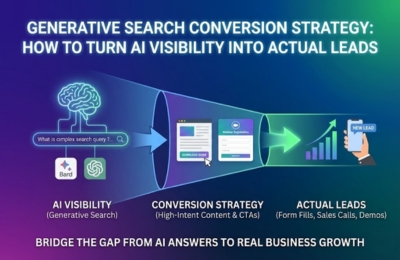
Generative search visibility alone does not drive revenue. This guide explains how a modern AI conversion strategy bridges the gap between AI impressions and real business outcomes. You’ll learn why traffic is no longer the primary metric, how the new AI-first funnel works, how trust drives clicks in LLM responses and which CTA and lead capture strategies convert AI-driven users into qualified leads.
Generative Search Conversion
Generative search has fundamentally changed how buyers discover brands. Instead of clicking through ten blue links, users now receive synthesized answers from AI systems like ChatGPT, Gemini, Claude and Google’s generative experiences. Visibility inside these answers is valuable, but visibility alone does not equal revenue.
This is where the AI conversion strategy becomes a commercial necessity. Brands that win in generative search are not just cited by AI; they are structured, trusted, and positioned to capture demand when AI-driven users are ready to act.
Why AI Visibility Doesn’t Equal Traffic
One of the biggest misconceptions in generative SEO is assuming that AI mentions automatically translate into clicks.
In reality, AI platforms behave differently from traditional search engines:
- AI answers often resolve intent without sending users away
- Users may consume brand mentions passively
- AI recommendations prioritize confidence and trust, not URLs
As a result, many brands experience high AI exposure with flat or declining website traffic. This is not a failure of SEO; it’s a shift in how conversion happens.
The opportunity lies in designing your content and offers so that AI-influenced users seek you out intentionally, rather than stumbling onto your site by chance. This requires rethinking the funnel itself.
The New AI Conversion Funnel
Traditional funnels assume linear behavior: search → click → read → convert. The AI-driven journey is different.
The modern AIO funnel looks more like this:
- AI Impression – Your brand appears in a generative response
- Trust Evaluation – The user assesses credibility through tone, clarity and authority
- Memory Retention – Your brand is mentally bookmarked
- Intent Re-entry – The user searches, asks, or navigates directly to you
- Conversion Action – Lead form, demo request, inquiry, or contact
This explains why generative SEO conversions often occur days or weeks after first exposure. AI influences the decision early, while the actual conversion happens later through branded or high-intent interactions.
Brands that design for this delayed conversion cycle outperform those chasing immediate clicks.
AI Trust-to-Click Sequence
AI systems act as trust filters. Before a user ever sees your site, the AI has already evaluated whether you are credible enough to recommend.
The trust-to-click sequence typically follows this pattern:
- Clarity over persuasion – AI favors clear, structured explanations
- Consistency over cleverness – Repeated positioning builds confidence
- Specificity over generalization – Concrete details outperform vague claims
When users encounter your brand repeatedly in AI responses, trust accumulates. Once that trust threshold is crossed, clicks become intentional and high-quality.
This is why conversion-focused generative strategies prioritize authority reinforcement over aggressive CTAs early in the journey.
For brands operating in sensitive or high-risk categories, aligning with principles from your internal AI safety alignment framework is critical to maintaining trust across AI platforms.
CTA Frameworks for AI-First Users
Calls-to-action in an AI-first environment must respect how users arrive at your brand. They are not cold visitors; they are pre-educated, pre-qualified and trust-aware.
Effective CTA frameworks for AI-driven users share three traits:
1. Validation-Based CTAs
These confirm what the user already believes.
Examples:
- “See how companies apply this strategy.”
- “Explore the framework behind this approach.”
2. Expansion-Based CTAs
These promise depth rather than persuasion.
Examples:
- “Get the full breakdown.”
- “View the implementation mode.l”
3. Risk-Reduction CTAs
These lower commitment while maintaining intent.
Examples:
- “Request a walkthrough.”
- “Preview how this works for your use case.”
These CTA styles outperform generic “Book a demo” or “Contact us” buttons when traffic originates from AI lead generation channels.
Lead Capture Strategies
Capturing leads from generative search requires aligning your conversion assets with AI-influenced behavior, not traditional SEO assumptions.
High-performing lead capture strategies include:
- Contextual landing pages aligned with AI answer themes
- Mid-content capture points instead of aggressive popups
- Educational offers that extend AI explanations
- Trust-first form design with minimal friction
Data from HubSpot AI buyer behavior research shows that AI-influenced buyers convert at higher rates when the offer deepens understanding rather than pushes urgency.
This reinforces a key principle: AI-driven leads convert when they feel guided, not sold to.
FAQs
How do I convert AI impressions into leads?
Focus on trust reinforcement, delayed conversion paths and AI-aligned CTAs. AI impressions influence intent early; conversions happen through intentional follow-up actions.
Does generative SEO replace traditional conversion optimization?
No. It extends it. Traditional CRO handles on-site behavior, while generative SEO conversions influence pre-site decision-making.
What metrics matter for an AI conversion strategy?
Brand searches, direct visits, assisted conversions and lead quality matter more than raw traffic volume.
How long does it take to see results from AI-driven lead generation?
Most brands see measurable impact within 60–90 days as AI visibility compounds and trust signals accumulate.
Conclusion
Generative search has not reduced conversion opportunities; it has redistributed them. The brands winning today are those that understand howan AI conversion strategy transforms visibility into intent, trust into action and AI exposure into measurable pipeline growth.
By designing around the AIO funnel, optimizing for the trust-to-click sequence, and deploying AI-first CTAs and lead capture systems, businesses can turn generative visibility into consistent, high-quality leads without chasing traffic that no longer exists.