
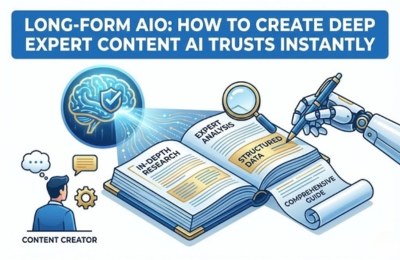
Long-form AIO works because AI systems reward depth, structure and semantic clarity, not surface-level repetition. This guide explains why AI trusts long-form content, how to structure authority articles, maintain semantic flow for LLMs, avoid repetition traps and use proven templates to create expert blogs AI recognizes instantly.
Long-Form AIO
Long-form AIO is not about writing more; it’s about proving expertise at machine scale. As AI-powered search engines and LLMs increasingly act as evaluators, curators and answer generators, shallow content simply doesn’t survive. What performs today is deep, structured, expert-led content that demonstrates topical mastery in a way both humans and AI can trust.
This shift is visible across Google’s AI Overviews, conversational search and standalone LLMs like ChatGPT, Gemini, Claude and Perplexity. These systems don’t “rank” content the old way; they validate authority signals embedded in long-form writing.
Why AI Trusts Long-Form Content
AI systems don’t trust length; they trust evidence of understanding.
Long-form content performs well because it naturally contains the signals LLMs are trained to recognize as expertise:
- Clear topic framing
- Contextual depth
- Logical progression of ideas
- Explicit differentiation between related concepts
- Consistent terminology usage
From a training perspective, LLMs learn from high-quality explanatory material, not summaries. Long-form articles resemble the instructional data AI was trained on, which is why expert blogs AI can reference feel familiar and reliable.
Research-backed UX and content studies from organizations like Nielsen Norman Group consistently show that users and algorithms value content that answers why, how and what next, not just what is.
This is why long-form AIO consistently outperforms thin content in AI visibility and trust scoring.
Structure of an AIO-Optimized Long Article
Structure is the invisible contract between your content and AI systems.
An AIO optimized long article follows a predictable but powerful hierarchy:
Clear Intent Declaration
AI needs to understand what problem this content solves. Strong introductions, explicit definitions and scoped promises reduce ambiguity.
Hierarchical Sectioning
Well-defined H2 and H3 sections help LLMs segment knowledge. Each section should address one conceptual layer, not multiple ideas blended together.
Progressive Depth
Instead of repeating points, each section should add a new dimension: definition → explanation → implication → application.
Embedded Authority Signals
Examples, frameworks and applied insights show AI that the content is based on experience, not aggregation.
This structural clarity is essential for authoritative articles that aim to perform across AI-driven environments.
Semantic Flow for LLMs
Semantic flow is how ideas move, not just how they’re written.
LLMs evaluate whether concepts connect logically across an article. If sections feel isolated or repetitive, trust drops. Strong semantic flow ensures that:
- Each section builds on the previous one
- Terminology remains consistent
- Related ideas are grouped, not scattered
- Transitions reinforce understanding
For deep content AIO, semantic flow acts like a roadmap. AI can trace how ideas evolve, which makes the content easier to summarize, reference and recommend.
This is where internal linking strategies, such as linking to topical depth AIO, strengthen conceptual continuity and reinforce subject authority across your site.
Depth vs Repetition
One of the most common AIO mistakes is confusing depth with repetition.
Depth means:
- Introducing new insights
- Expanding the concept from different angles
- Adding nuance, constraints, or trade-offs
Repetition means:
- Restating the same idea with different words
- Reusing examples without added insight
- Padding length without increasing value
AI systems are particularly sensitive to repetition. They detect semantic overlap quickly and downgrade content that appears inflated rather than informative.
High-performing expert blogs AI trusts deliberately avoid redundancy. Each paragraph earns its place by contributing something new.
Templates
To apply long-form AIO consistently, templates matter.
Below are layout templates designed specifically for AI trust and authority signaling:
Template 1: Authority Explainer
- Intent framing
- Concept definition
- Why it matters
- How it works
- Practical implications
Template 2: Expert Framework Article
- Problem statement
- Model or framework explanation
- Step-by-step breakdown
- Risks or limitations
- Strategic takeaway
Template 3: Deep-Dive Analysis
- Context and background
- Core mechanisms
- Comparative insights
- Future implications
- Expert conclusion
These templates prevent overwriting while ensuring depth, semantic clarity and repeatable success in long-form AIO.
FAQs
Does long-form help AI ranking?
Yes. Long-form content helps AI systems evaluate expertise, context and semantic completeness, which increases trust and visibility across AI-powered search results.
How long should an AIO article be?
Length matters less than depth. Most effective AIO articles fall between 1,200 and 1,500 words when each section contributes new, meaningful insight.
Is long-form better than multiple short articles?
For AI trust, a single authoritative long-form piece often performs better than fragmented short content, especially for complex or expert-driven topics.
Can long-form AIO work without backlinks?
Yes. AI systems increasingly rely on content quality, structure and topical authority signals, not just backlinks, to assess trustworthiness.