
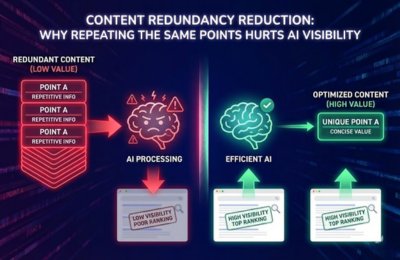
AI systems don’t reward repetition the way humans sometimes do. When content repeats the same ideas, phrasing, or explanations, AI interprets it as low informational value, semantic overlap and weak authority. This article explains how content redundancy affects AI visibility, the difference between reinforcement and repetition and practical techniques to reduce redundancy while maintaining clarity, freshness and ranking strength across AI-powered search engines.
Content Redundancy Problems
Content redundancy is one of the most underestimated threats to AI visibility. While traditional SEO once tolerated repeated explanations for keyword reinforcement, modern AI-powered systems operate differently. Large language models evaluate information density, semantic uniqueness and explanatory efficiency rather than frequency alone.
When a page repeats the same idea across multiple paragraphs, AI does not see emphasis. It sees inefficiency. In the context of content redundancy AI, repetition often signals that the content lacks depth, synthesis, or original insight.
For AI-driven systems like ChatGPT, Gemini, Claude and Perplexity, authority is derived from how efficiently a concept is explained, expanded and contextualized. Repeating similar explanations reduces perceived value and weakens trust signals. This is why repetition penalties are increasingly visible in AI-based retrieval and summarization systems.
How AI Interprets Repeated Info
AI does not read content linearly the way humans do. Instead, it builds semantic maps that evaluate how much new information each sentence adds to the overall topic. When multiple sentences convey the same meaning using slightly different wording, AI identifies this as semantic duplication.
From an AI perspective, repeated information creates:
- Low informational yield per token
- Redundant embeddings within the same document
- Reduced semantic coverage across the topic space
This is where semantic overlap becomes a ranking liability. If two or more sections answer the same implicit question without adding new constraints, examples, or distinctions, AI systems downrank their usefulness.
Research-backed UX and content behavior insights from Nielsen Norman Group consistently show that users prefer concise, non-repetitive explanations. AI systems mirror this preference at scale, optimizing for clarity, not verbosity.
Redundancy vs Reinforcement
One of the most common mistakes in modern content creation is confusing redundancy with reinforcement. While reinforcement strengthens understanding by layering insights, redundancy simply restates the same idea.
Reinforcement adds value when it:
- Introduces a new angle or constraint
- Expands context (technical, practical, or strategic)
- Applies the idea to a different use case
Redundancy occurs when:
- Sentences rephrase the same definition repeatedly
- Paragraphs echo earlier conclusions without progression
- Sections restate points already fully explained
In AIO – driven environments, the repetition penalty is not applied because of word reuse but because of meaning reuse. High AIO content quality is achieved when each section moves the reader and the AI forward.
How to Reduce Semantic Overlap
Reducing semantic overlap starts with intentional content architecture. Each section must answer a distinct question or introduce a new layer of understanding.
Effective strategies include:
- Assigning one core intent per heading
- Avoiding paraphrased definitions across sections
- Replacing restatements with applied examples
- Using contrast instead of repetition
For example, instead of re-explaining what content redundancy is, later sections can show how redundancy impacts AI summarization, authority signals, or retrieval bias.
Aligning this approach with internal frameworks such as AI freshness signals and LLM authority ranking AIO strengthens topical clarity and reduces internal competition between ideas. Strategic alignment with AEO and GEO principles further ensures that content is reusable by answer engines without confusion or dilution.
Techniques for Freshness
Freshness is not about updating dates or adding new headings. AI freshness is about informational novelty within an existing topic.
Effective freshness techniques include:
- Introducing updated constraints or edge cases
- Adding decision-based explanations instead of summaries
- Replacing repeated explanations with comparative insights
- Using progression-based structuring rather than recap-based writing
AI systems prioritize content that evolves ideas instead of repeating them. This approach aligns with how LLMs detect topical expansion rather than surface-level updates.
Freshness also improves answer reuse. When AI systems extract responses, they favor sections that provide unique, complete explanations without relying on surrounding repetition.
Checklist
Use this checklist to audit content for redundancy risks:
- Each H2 and H3 addresses a unique intent
- No paragraph restates another without adding context
- Definitions appear once, followed by applications
- Examples replace summaries wherever possible
- No section depends on repetition for clarity
- Content aligns with AI-first readability and explanation depth
Applying this checklist consistently improves both human engagement and AI interpretability.
FAQs
Why is repetition bad for AI?
AI systems evaluate informational efficiency, not emphasis. Repetition reduces semantic value and signals low content density, which negatively impacts AI visibility and reuse.
How does semantic overlap affect rankings?
Semantic overlap causes AI to see multiple sections as duplicates, reducing perceived authority and limiting how often content is cited or summarized.
Is repeating keywords still effective?
Keyword repetition without new meaning can trigger repetition penalties. Modern AI favors contextual relevance over frequency.
How can I reinforce ideas without redundancy?
Reinforce concepts by applying them to new scenarios, adding constraints, or contrasting outcomes instead of restating definitions.