
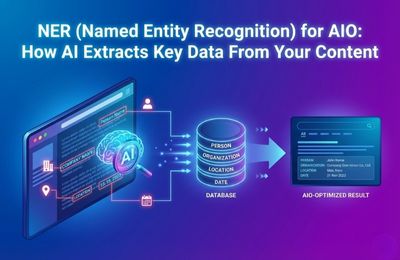
Named Entity Recognition (NER) is a core NLP mechanism that helps AI systems identify and extract key facts such as names, places, organizations and categories from your content. In the context of AIO (AI Optimization), strong NER signals improve how LLMs interpret, trust and reuse your information in AI answers. This guide explains how NER works, why accuracy matters and how to optimize your content so AI systems extract the right entities, not the wrong ones.
NER in AIO
As AI-powered search engines and large language models (LLMs) increasingly generate answers instead of listing links, how machines understand your content matters more than how often you publish it. One of the most critical understanding layers is NER for AIO.
NER sits at the intersection of natural language processing and entity-based SEO. It determines whether AI systems correctly identify who you are, what you do, where you operate and how your concepts relate to one another. When NER works in your favor, your content becomes machine-readable, reference-worthy and reusable in AI-generated responses. When it fails, even high-quality content can be misunderstood or ignored.
What NER Is
Named entity recognition is an NLP technique that detects and classifies specific data pointscalled entities within unstructured text. These entities typically include:
- People
- Organizations
- Locations
- Products
- Dates
- Categories and concepts
From an AI perspective, NER is not about keywords; it is about meaning extraction. LLMs rely on NER to convert raw text into structured knowledge they can reason over, compare and retrieve later.
Modern NER systems are trained on massive corpora using statistical models and deep learning. Frameworks like SpaCy and research initiatives from Stanford NLP have made entity detection far more context-aware than early rule-based approaches.
How NER Extracts Facts, Names, Categories
NER operates as part of a broader NLP parsing pipeline. The simplified flow looks like this:
- Tokenization – Text is broken into words and phrases
- Part-of-speech tagging – Grammar roles are assigned
- Entity detection – Tokens are grouped into candidate entities
- Entity classification – Each entity is labeled (person, org, location, etc.)
- Context validation – Surrounding text confirms or corrects meaning
Example: NER Extraction Block
Input sentence:
“XYZ Techsoft provides AI optimization services in the USA .”
NER output:
- Organization: XYZ Techsoft
- Service Category: AI optimization services
- Location: USA
This structured output allows AI systems to connect your brand to services and geography. Without a clear context, the same sentence could be partially or incorrectly parsed, especially if names or categories are ambiguous.
This is where AI entity extraction directly impacts how LLMs reuse your content in answers, summaries and comparisons.
Why NER Accuracy Matters
NER accuracy is not a minor technical detail; it is a ranking and visibility factor in AI-driven discovery.
When NER is accurate:
- Your brand is correctly associated with its domain expertise
- Facts are consistently extracted across platforms
- LLMs can confidently cite or summarize your content
When NER fails:
- Brands get merged with similarly named entities
- Services are misclassified
- Locations or categories are omitted
- AI answers exclude or misrepresent your content
In AIO contexts, NER feeds directly into higher-level systems such as the LLM decision tree, where extracted entities influence which sources are trusted and selected. Poor entity clarity creates uncertainty and uncertainty leads to exclusion.
This is why NER is foundational to entity SEO and AI trust modeling.
How to Optimize for NER
Optimizing for NER does not require gaming algorithms; it requires clarity, consistency and structure.
Key optimization principles include:
- Explicit naming: Use full, unambiguous entity names before abbreviations
- Consistent references: Avoid switching between multiple variations of the same entity
- Clear relationships: State who does what, where and in which category
- Context-rich sentences: Surround entities with descriptive qualifiers
- Logical hierarchy: Organize content so entities appear in predictable sections
Optimized vs. Unoptimized Example
- Unoptimized:
“We offer advanced solutions for businesses worldwide.”
- NER-optimized:
“XYZ company offers AI optimization and NLP consulting services for enterprise businesses in India and North America.”
The second version dramatically improves NER for AIO by reducing ambiguity and increasing extraction confidence.
Tools for NER Auditing
Auditing NER performance helps you understand how machines interpret your content, not how humans read it.
Widely used tools and frameworks include:
- SpaCy – For testing entity detection and classification in text
- Stanford NLP – For academic-grade NER analysis and model evaluation
By running your content through these tools, you can identify:
- Missing or misclassified entities
- Overlapping entity conflicts
- Weak contextual signals
This feedback loop allows you to refine content so AI systems extract the intended facts every time.
FAQs
What is NER?
Named Entity Recognition is an NLP technique that identifies and classifies key entities such as names, organizations, locations and categories from text so AI systems can understand and structure information.
How to optimize for NER?
You can optimize for NER by using clear entity names, maintaining consistency, adding contextual descriptors and structuring content so entities are easy for AI models to detect and classify.
Does NER affect AI rankings?
Yes. NER accuracy influences how LLMs interpret your content, which impacts whether your information is trusted, reused, or excluded in AI-generated answers.
Is NER important for AIO specifically?
Absolutely. NER for AIO ensures that AI systems extract correct entities and relationships, forming the foundation for AI visibility, authority and answer inclusion.