
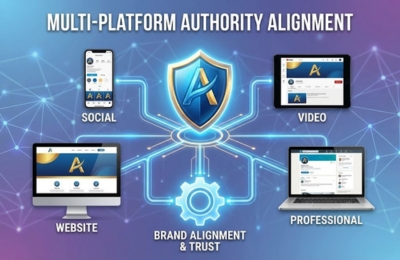
Modern AI systems don’t judge your brand by one page or one platform. They evaluate authority alignment across every digital touchpoint, including your website, LinkedIn, profiles, citations, and knowledge sources. When bios, facts and claims don’t match, AI confidence drops, resulting in weaker visibility, fewer citations and inaccurate brand answers. This guide explains how AI checks cross-platform consistency, what must align, how to audit mismatches and the authority benefits of getting it right.
Multi-Platform Alignment
In traditional SEO, consistency was a branding best practice. In AI-powered search, consistency is an authority requirement.
Large Language Models don’t “rank” pages in isolation. They synthesize information across multiple platforms to determine whether a brand deserves trust. This is where authority alignment AI becomes critical. When your brand messaging, credentials and factual data match everywhere, AI can confidently reference you. When they don’t, your brand becomes unstable in AI outputs.
This instability is one of the most common reasons brands fail to appear in AI-generated answers, even when their content quality is high.
Why AI checks cross-channel consistency
AI systems are trained to detect patterns, reinforcement and contradiction. When evaluating a brand, they don’t assume any single source is correct.
Instead, they ask:
- Do multiple platforms confirm the same identity?
- Are claims supported consistently across channels?
- Does expertise remain stable regardless of context?
This is how brand consistency AI works in practice.
For example, if your website positions you as an enterprise AI consultancy, but your LinkedIn bio emphasizes generic IT services, the model detects uncertainty. The result is reduced confidence in your authority.
Research from the Stanford NLP Group highlights that AI systems favor cross-source agreement when generating factual or expert-level answers. Conflicting signals increase the likelihood of omission or generic responses rather than precise brand mentions.
This directly impacts cross-platform visibility in AI answers.
What needs to match (bio, facts, claims)
AI doesn’t require identical wording, but it does require semantic alignment.
The most critical elements that must match across platforms include:
1. Brand identity signals
Your name, description, positioning and expertise category should be consistently framed. Minor phrasing changes are acceptable, but meaning must remain stable.
2. Factual data
This includes:
- Company scope
- Service focus
- Locations
- Years of experience
- Certifications or partnerships
If one platform lists five years of experience and another implies a decade, AI flags uncertainty.
3. Authority claims
Claims such as “industry leader,” “enterprise-grade,” or “trusted by global clients” must be supported across channels. Unsupported claims weaken trust signals rather than strengthen them.
4. Topic association
AI associates brands with topics based on repetition. If your blog focuses on AI strategy but social profiles emphasize unrelated services, the association becomes diluted.
Real-world mismatch example:
A SaaS brand optimized its website for AI governance but maintained outdated directory profiles describing it as a generic analytics tool. AI systems repeatedly answered governance-related queries without citing the brand, despite strong on-site content, because cross-platform alignment was missing.
Audit and alignment steps
Fixing authority alignment is not about rewriting everything. It’s about controlled convergence.
A practical alignment audit includes:
Step 1: Inventory all AI-visible platforms
This includes your website, LinkedIn, business profiles, author bios and high-authority citations.
Step 2: Normalize core facts
Create a single source of truth for brand identity, expertise and claims. Everything else aligns with this.
Step 3: Resolve semantic drift
Look for subtle contradictions, not just obvious errors. Differences in positioning language matter more than formatting.
Step 4: Strengthen internal reinforcement
Use strategic internal references such as LLM authority ranking and AIO internal linking to reinforce consistent topic authority within your own ecosystem.
Step 5: Monitor AI outputs
Ask AI platforms how they describe your brand. If answers vary, alignment is incomplete.
This process directly improves AI’s confidence when selecting your brand as a reference.
Authority benefit
When alignment is achieved, the benefits compound.
AI systems begin to:
- Reference your brand more confidently
- Use your explanations as default answers
- Reduce hallucination or misattribution
- Treat your brand as a stable authority entity
This is the long-term payoff of authority alignment AI. It doesn’t just improve visibility it improves accuracy, trust and recall across AI-powered search.
Brands that maintain alignment experience stronger cross-platform visibility, even without aggressive publishing, because AI trusts what it already understands.
FAQs
Does brand consistency affect AI ranking?
Yes. AI systems rely on cross-source agreement. Inconsistent branding reduces confidence, leading to weaker visibility or omission in AI-generated answers.
How does AI detect brand mismatches?
AI compares semantic meaning across platforms. Conflicting facts, positioning, or claims signal uncertainty, lowering authority trust.
Is identical wording required across platforms?
No. AI looks for meaning alignment, not duplication. Consistent intent matters more than exact phrasing.
How often should alignment audits be done?
Alignment audits should be done quarterly or whenever services, positioning, or authority claims change.