
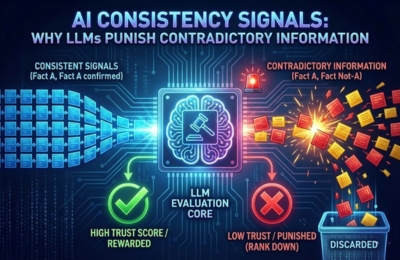
Large Language Models (LLMs) prioritize AI consistency as a core trust signal. When your content, data, or brand messaging contradicts itself across pages or platforms, AI systems downgrade confidence, reduce reuse and limit visibility. This guide explains how AI checks consistency, why conflicting data hurts reach and how to fix alignment issues across your entire digital footprint.
Consistency Signals
AI-powered search engines and answer systems don’t just scan pages for keywords. They evaluate whether your information agrees with itself over time, format and source. Consistency signals help LLMs decide if a brand or website is reliable enough to cite, summarize, or surface inside AI-generated answers.
In technical terms, consistency is about whether facts, claims, terminology and positioning remain stable across your ecosystem. When signals align, AI builds confidence. When they don’t, visibility drops.
How AI Checks Consistency
LLMs assess consistency by comparing multiple layers of information rather than trusting a single page. These checks are automated, probabilistic and cross-referenced at scale.
Key mechanisms include:
- Intra-site comparison: AI compares statements across your own pages, blogs, FAQs and structured data.
- Inter-source validation: Claims are checked against other indexed sources discussing similar topics.
- Temporal analysis: Older content is compared with newer updates to detect unexplained shifts.
- Semantic matching: Different phrasings with the same intent are evaluated for meaning-level agreement.
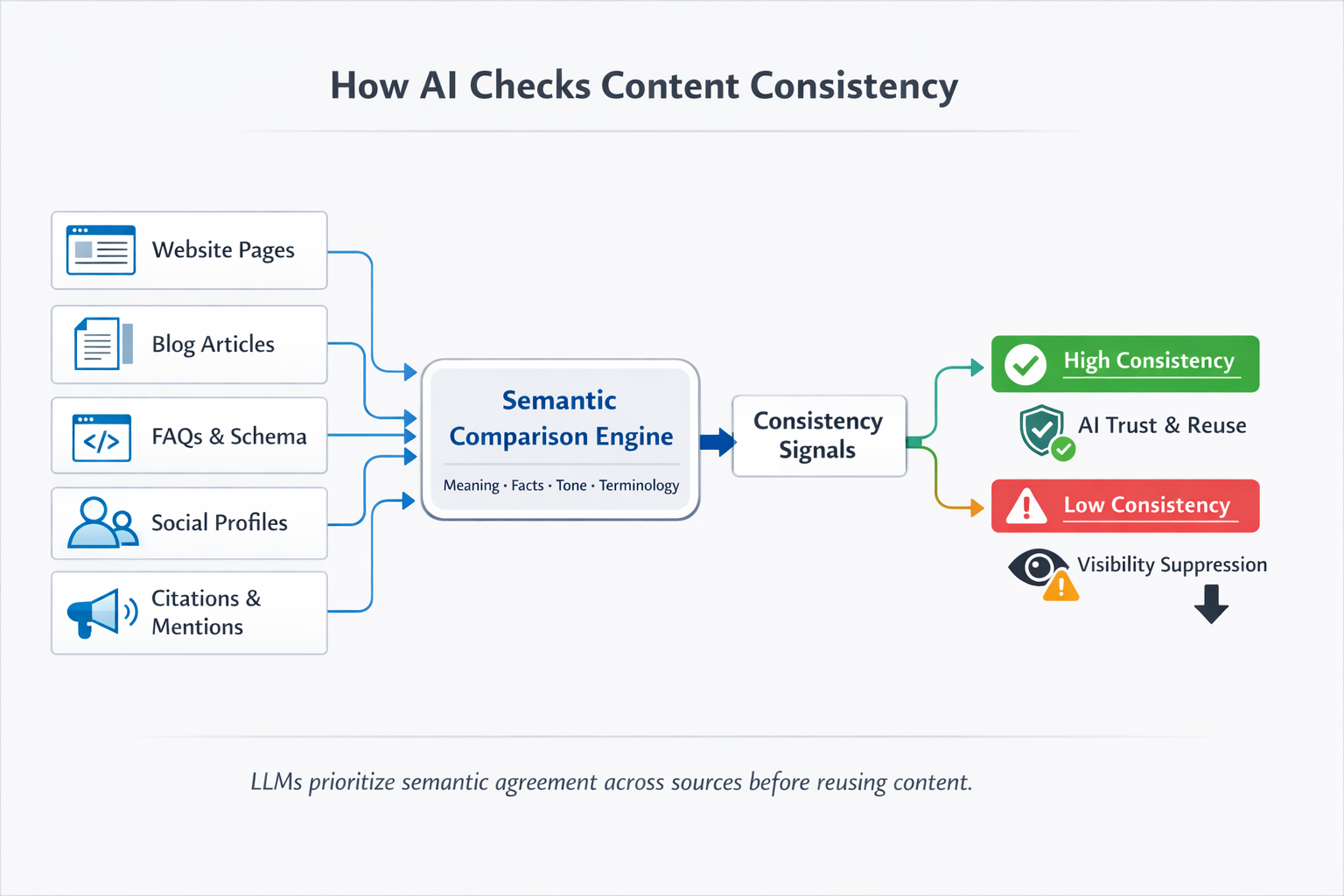
For example, if one page lists a service price, another page suggests a different range and a third omits pricing entirely, AI flags uncertainty. Even when humans understand context, LLMs interpret divergence as risk.
This is why technical foundations like AI crawlability matter. If AI can’t reliably discover and reconcile your pages, consistency signals weaken before interpretation even begins.
How Conflicting Data Reduces Visibility
Contradictory information directly affects whether AI systems choose to reuse your content. LLMs are optimized to avoid misinformation, so uncertainty leads to exclusion.
Here’s how conflicts hurt performance:
- Lower trust scoring: Inconsistent facts reduce confidence in accuracy.
- Reduced citation likelihood: AI avoids sources with unresolved discrepancies.
- Suppressed summarization: Content is skipped when signals clash.
- Weakened authority signals: Expertise becomes harder to establish.
For instance, if your brand claims “industry-leading” expertise in one article but presents beginner-level explanations elsewhere without clarity, AI struggles to classify your authority level. The result is fewer appearances in AI answers, even if individual pages rank well in traditional search.
Research in computational linguistics, as referenced by Stanford NLP, indicates that language models tend to favor sources with stable, repeatable patterns over those with fluctuating claims.
Brand Voice & Message Stability
Consistency isn’t limited to facts. Brand voice, tone and positioning also act as AI trust signals.
LLMs learn patterns. When your brand voice swings between:
- Formal and casual without reason
- Expert-level and entry-level without framing
- Promotional and neutral without context
AI detects fragmentation. Stable messaging helps models associate your brand with a clear role: expert, educator, vendor, or analyst. This clarity increases reuse because AI can confidently select your content for the right intent.
Message stability includes:
- Repeating core value propositions using aligned language
- Using consistent terminology for services and concepts
- Maintaining a predictable level of technical depth
This is especially important when content is parsed alongside structured frameworks like schema types AI, where mismatched definitions can undermine otherwise strong signals.
Cross-Platform Alignment
LLMs don’t treat your website in isolation. They analyze brand mentions across platforms, formats and contexts.
Common alignment gaps include:
- Website claims vs. social media bios
- Blog content vs. press releases
- Product descriptions vs. third-party listings
- FAQs vs. support documentation
When these sources disagree, AI confidence erodes. Even minor differences, such as inconsistent service names or varying feature lists, can fragment your entity understanding.
Cross-platform alignment ensures that:
- The same facts appear everywhere they are mentioned
- Updates propagate consistently
- Old content is retired or redirected, not contradicted
This alignment strengthens source alignment signals, making it easier for AI to confirm your accuracy across the web.
Fixing Inconsistency Issues
Resolving consistency problems is a technical and editorial process. It requires system-wide review, not isolated edits.
A practical approach includes:
- Content inventory: List all pages, assets and profiles that describe your offerings or expertise.
- Fact normalization: Standardize dates, statistics, definitions and claims.
- Message mapping: Define approved phrasing for core concepts and services.
- Version control: Update older content or clearly contextualize changes.
- Schema validation: Ensure structured data matches on-page content.
- Ongoing monitoring: Regularly recheck alignment as new content is published.
The goal is not to sound repetitive, but to be semantically consistent. Different wording is fine, but a contradictory meaning is not.
When consistency is restored, AI trust signals stabilize and visibility improves naturally across generative systems.
FAQs
Why does inconsistency hurt AI ranking?
LLMs prioritize reliability. When information conflicts, AI systems lower confidence and reduce reuse to avoid spreading potential inaccuracies.
How do LLMs detect contradictory content?
They compare meaning across pages, timestamps, sources and structured data to identify mismatches in facts or messaging.
Is brand voice consistency really important for AI?
Yes. Stable tone and positioning help AI classify your expertise level and intent, increasing the chance of being cited or summarized.
How often should consistency audits be done?
Ideally, on a rolling basis, especially after major updates, rebrands, or new content launches.