
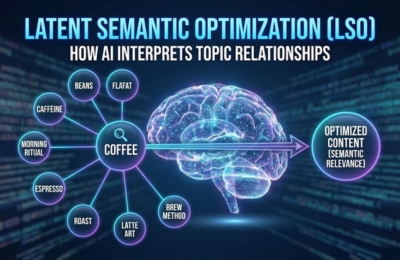
Latent Semantic Optimization (LSO) is how modern AI systems interpret meaning, not just keywords. Instead of matching exact phrases, LLMs analyze semantic relationships, topic depth and contextual consistency across content. This guide explains how semantic optimization AI works, how it differs from traditional LSI and how to build semantic clusters that improve visibility in Google AI Overviews and AI answer engines like ChatGPT and Gemini.
Semantic Optimization for AIO
Search optimization has shifted from keywords to meaning. In an AI-first search environment, ranking is no longer driven by keyword density but by how clearly your content explains a topic and its relationships.
Semantic optimization AI focuses on how concepts connect:
- Core topic → subtopics → supporting ideas
- Definitions → applications → implications
- Consistent terminology across pages
Latent Semantic Optimization (LSO) is the evolution of semantic SEO for Artificial Intelligence Optimization (AIO). It helps Large Language Models (LLMs) understand what you mean, how well you understand it and whether your explanation is trustworthy enough to reuse.
This is why pages optimized only for keywords struggle to appear in Google AI Overviews or AI-generated answers.
How LLMs Read Semantic Connections
LLMs do not “scan” pages the way traditional crawlers do. They interpret content using probabilistic language models trained on patterns of meaning.
Here’s how semantic optimization AI works at a conceptual level:
Concept Recognition
- LLMs identify primary entities, concepts and topical intent. For example, “semantic optimization” is understood alongside language models, context and meaning-based ranking.
Relationship Mapping
AI builds connections between related ideas:
- Cause and effect
- Definitions and examples
- Parent topics and child topics
Context Reinforcement
- The more consistently related terms appear together, the higher the confidence score. This is why semantic clusters matter more than isolated keywords.
Cross-Source Validation
- AI compares your explanations against known semantic patterns across the web. Content that aligns with authoritative academic and technical explanations is more likely to be trusted.
This process mirrors how research papers are evaluated in platforms like Semantic Scholar, where meaning, citations and conceptual clarity determine relevance.
LSO vs LSI
Many marketers still confuse LSO with LSI keywords AI, but they are not the same.
LSI (Latent Semantic Indexing):
- An older information retrieval concept
- Focused on keyword co-occurrence
- Used to reduce ambiguity in traditional search engines
- Often misused as “synonym stuffing.”
LSO (Latent Semantic Optimization):
- Designed for AI-driven interpretation
- Focuses on meaning-based SEO, not keywords
- Builds topic authority through structured explanation
- Optimizes for AI recall, not just ranking
In short:
- LSI keywords AI help search engines
- Semantic optimization AI helps language models
This distinction is critical if you want visibility in AI-powered summaries such as Google AI Overviews, where the model selects content based on semantic completeness rather than keyword signals.
How to Build Semantic Depth
Semantic depth is the strongest signal in meaning-based SEO. It answers one core question AI asks:
“Does this content fully explain the topic?”
To build semantic depth:
1. Start with a Core Topic
Define one clear primary concept and stay aligned with it throughout the page.
2. Expand into Semantic Clusters
Each cluster should naturally support the main topic:
- Definitions
- Comparisons
- Applications
- Processes
- Evaluation criteria
3. Maintain Terminology Consistency
Avoid switching terms unnecessarily. AI prefers stable phrasing that reinforces meaning.
4. Cover Intent Layers
Strong semantic optimization AI content answers:
- What it is
- How it works
- Why it matters
- How to apply it
5. Connect Related Pages
Internal linking to conceptually aligned content, such as entity SEO, strengthens semantic understanding across your site and helps AI interpret topical authority.
This approach mirrors how topic trees are structured in AI training datasets.
Examples of Semantic Expansion
Consider a page targeting semantic optimization AI.
Shallow approach (keyword-based):
- Repeats “semantic SEO” multiple times
- Adds unrelated synonyms
- Lacks structure
Semantic expansion approach:
- Explains how AI interprets meaning
- Compares LSO vs LSI
- Shows how semantic clusters work
- Includes practical checklists
- References authoritative sources like Semantic Scholar
This creates a semantic network that AI can confidently reuse when generating answers.
For example, when a user asks:
“How does AI understand topic relationships?”
AI is more likely to cite content that:
- Explains relationships clearly
- Uses structured sections
- Demonstrates conceptual depth
- Aligns with known academic frameworks
This is how meaning-based SEO translates directly into AI visibility.
Checklist
Use this checklist to validate semantic optimization for AIO:
- Clear primary topic defined
- Supporting subtopics are logically connected
- Semantic clusters built around intent
- LSO vs LSI distinction explained
- Internal links to entity-relevant content (e.g., entity SEO, Google AI Overviews)
- External validation via authoritative sources
- No keyword stuffing or redundancy
- Consistent terminology across sections
If your content passes this checklist, it is optimized not just for ranking—but for AI reuse.
FAQs
What is semantic SEO?
Semantic SEO focuses on optimizing content around meaning and topic relationships rather than individual keywords. It helps AI and search engines understand context, intent and relevance.
How does AI use semantic signals?
AI analyzes semantic signals by mapping relationships between concepts, evaluating contextual consistency and comparing explanations across trusted sources to assess accuracy and depth.
Are LSI keywords still relevant?
LSI keywords AI concepts are outdated for modern optimization. While related terms still matter, AI prioritizes semantic structure and topic completeness over keyword co-occurrence.
Does semantic optimization help with AI overviews?
Yes. Meaning-based SEO is a core factor in how content is selected for AI-generated summaries like Google AI Overviews and other LLM-powered answer engines.