
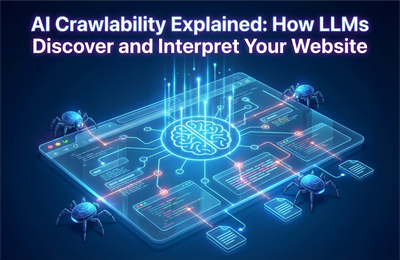
AI crawlability determines how large language models (LLMs) discover, interpret and reuse your website’s content inside AI-powered search and answer engines. Unlike traditional Google crawling, AI systems prioritize semantic clarity, entity consistency and generative crawl paths over raw link discovery. This guide explains how AI crawlability works, how it differs from Google crawl behavior, which signals matter most,and how to optimize your site so LLMs can reliably read, understand and recall your content.
AI Crawlability
AI crawlability refers to how effectively artificial intelligence systems especially large language models can discover, parse and interpret your website content for reuse in AI-generated answers.
Traditional SEO focused heavily on how Googlebot crawls and indexes pages. AI crawlability adds a second layer: how non-traditional crawlers and retrieval systems understand your site as structured knowledge rather than just URLs.
AI crawl vs Google crawl (high-level comparison)
- Google crawl: Link-driven, index-first, ranking after retrieval
- AI crawl: Context-driven, meaning-first, retrieval optimized for generation
This shift means your website must be optimized not just to be found, but to be understood.
How AI Discovers Websites
LLMs do not crawl the web in a single, unified way. Instead, AI discovery happens through multiple overlapping mechanisms that create what we call generative crawl paths.
Key AI discovery sources
- Publicly accessible web content
- High-authority domains and frequently cited pages
- Structured data feeds and sitemaps
- Mentions across trusted sources
- APIs, documentation hubs and reference-style content
Unlike Googlebot, which follows hyperlinks exhaustively, AI systems prioritize signal-rich entry points. Pages that clearly explain concepts, define entities and connect ideas are far more likely to be discovered.
Practical comparison
- Google discovers pages by crawling links at scale
- AI discovers pages by identifying authoritative, reusable explanations
This is why many pages that rank well on Google still fail to appear in AI answers they are crawlable, but not AI-readable.
How LLMs Read & Interpret Pages
Once discovered, LLMs interpret pages very differently from traditional search engines.
What LLMs actually “read”
LLMs analyze:
- Semantic structure (headings, hierarchy, clarity)
- Concept definitions and relationships
- Consistency of terminology
- Context across sections, not isolated keywords
They do not store pages as indexes alone. Instead, they transform content into internal representations that can be recalled later during answer generation.
Why keyword optimization alone fails
A page optimized only for keywords may rank, but it often:
- Lacks clear entity definitions
- Repeats phrases without explaining meaning
- Breaks context across sections
For LLM crawling, clarity beats density. Well-explained concepts outperform keyword-stuffed pages.
Crawl Signals That Matter
AI crawlability depends on a distinct set of signals that differ from traditional ranking factors.
High-impact AI crawl signals
- Clear topic focus per page
- Logical H1–H3 structure
- Consistent terminology across sections
- Explicit explanations (what, why, how)
- Low ambiguity in page intent
Signals that matter less for AI
- Excessive internal linking without context
- Over-optimized anchor text
- Thin pages created only for keyword coverage
In AI search indexing, quality of understanding outweighs quantity of URLs.
XML Sitemaps for AI
XML sitemaps still play a role but their purpose has evolved.
What sitemaps do for AI
- Provide clean discovery paths
- Highlight canonical, authoritative URLs
- Reduce ambiguity around page priority
What sitemaps cannot do
- Force AI systems to interpret low-quality pages
- Compensate for unclear content
- Replace semantic clarity
Think of sitemaps as navigation aids, not intelligence boosters. Without readable content, even a perfect sitemap won’t improve AI crawlability.
AI Crawl Errors to Avoid
Many crawl issues now happen after discovery during interpretation.
Common AI crawlability mistakes
- Pages that mix multiple intents
- Overuse of jargon without explanation
- Inconsistent naming for the same concept
- Missing contextual introductions
- Thin pages relying on internal links for meaning
AI crawl vs Google crawl errors
- Google errors = blocked pages, 404s, duplicate URLs
- AI errors = misunderstood pages, ignored concepts, low recall
Your site can be technically crawlable yet effectively invisible to AI.
Crawl Optimization Checklist
Use this checklist to improve AI crawlability without changing your core SEO foundation.
Technical & structural
- One primary topic per page
- Clear H1 supported by logical H2–H3 flow
- Clean URLs and canonical signals
- Updated XML sitemap
Content & interpretation
- Define key concepts early on the page
- Use consistent language throughout
- Explain relationships between ideas
- Avoid unnecessary filler sections
Strategic
- Link internally to authoritative context (for example, from an AIO consultant resource page where relevant)
- Reference trusted documentation such as OpenAI system documentation when discussing AI behavior
- Write with reuse in mind: answers, not just rankings
FAQs
Does AI crawl websites?
Yes. AI systems discover and process publicly available web content through multiple discovery paths. However, they interpret pages based on semantic clarity rather than traditional indexing alone.
How can I improve AI crawlability?
Focus on clear structure, consistent terminology, defined concepts and strong contextual explanations. Technical crawlability is necessary, but understanding is what drives AI reuse.
Is AI crawlability different from Google crawlability?
Yes. Google prioritizes indexation and ranking signals, while AI prioritizes comprehension and answer reuse. A page can rank on Google yet still be ignored by AI systems.
Do XML sitemaps help AI crawl content?
They help with discovery but do not guarantee interpretation. Sitemaps support AI crawl paths, but content clarity determines whether pages are actually used.